
HOW IT WORKS
From the draw to a recommendation
— step by step.
A citizens' assembly is not a poll, nor a referendum, nor a panel of experts. It is a participatory format with a clear methodology — where decisions are made by residents who were selected by lot and given time to understand the topic in depth.
STEP 01 · REGISTRATION
Before we draw, people have to sign up.
A citizens' assembly begins with open registration. We send every resident of Prague 1 a leaflet with an invitation; we also publish the call on social media and on our website. You can register from the menu via "I want to get involved".
Registration is open to anyone — the principle can be used in another neighbourhood, another city, even nationwide. We are currently running the process for Prague 1, which is why the whole page is shaped around this city district and the numbers below are a concrete example from Prague 1.
STEP 02 · THE DRAW
From the applicants
we select 100
who match the
district.
The principle is general: the sample proportionally matches the composition of a given area — by place of residence, age and gender. We draw on public data from the Czech Statistical Office. Right now we are running the process in Prague 1, so here we draw 100 participants and 2 substitutes to match the composition of this city district — the New Town, Old Town, Malá Strana. The draw is public and anonymous — from sequential numbers, in the presence of representatives of civic associations and the political representation of the Prague 1 district.
What is "statistical selection"?
The group's composition matches the share of representation of an area's residents. In Prague 1 it looks like this: if 51 % of residents live in the New Town, we draw roughly 51 of the 100 participants from there. The same goes for age groups and gender. An ideal sample would also account for the links between criteria (e.g. how many young people live in Malá Strana) — but cross-tabulated data at the necessary level of detail is not publicly available. We work with what we have — and we add a public draw overseen by representatives of civic associations and the political representation. The same principle adapts to another area.
STEP 03 · CHOICE OF TOPIC
The participants choose the topic themselves.
Who sets the topic depends on whether the assembly arises from the bottom up — on a citizens' initiative — or from the top down (e.g. commissioned by the city). In a bottom-up assembly the participants choose the topic themselves; in a top-down one the topic or specific question may be formulated in advance.
In Prague 1 we wanted to find the topic ourselves — so we used the already approved Sustainable Development Strategy of the Prague 1 district as a map. It helped participants understand the environment, get to the data from research and see problems in context before they began choosing a question. Elsewhere it depends on whether it is a bottom-up initiative or a top-down commission.
Short-term rentals
STEP 04 · AT THE MEETING
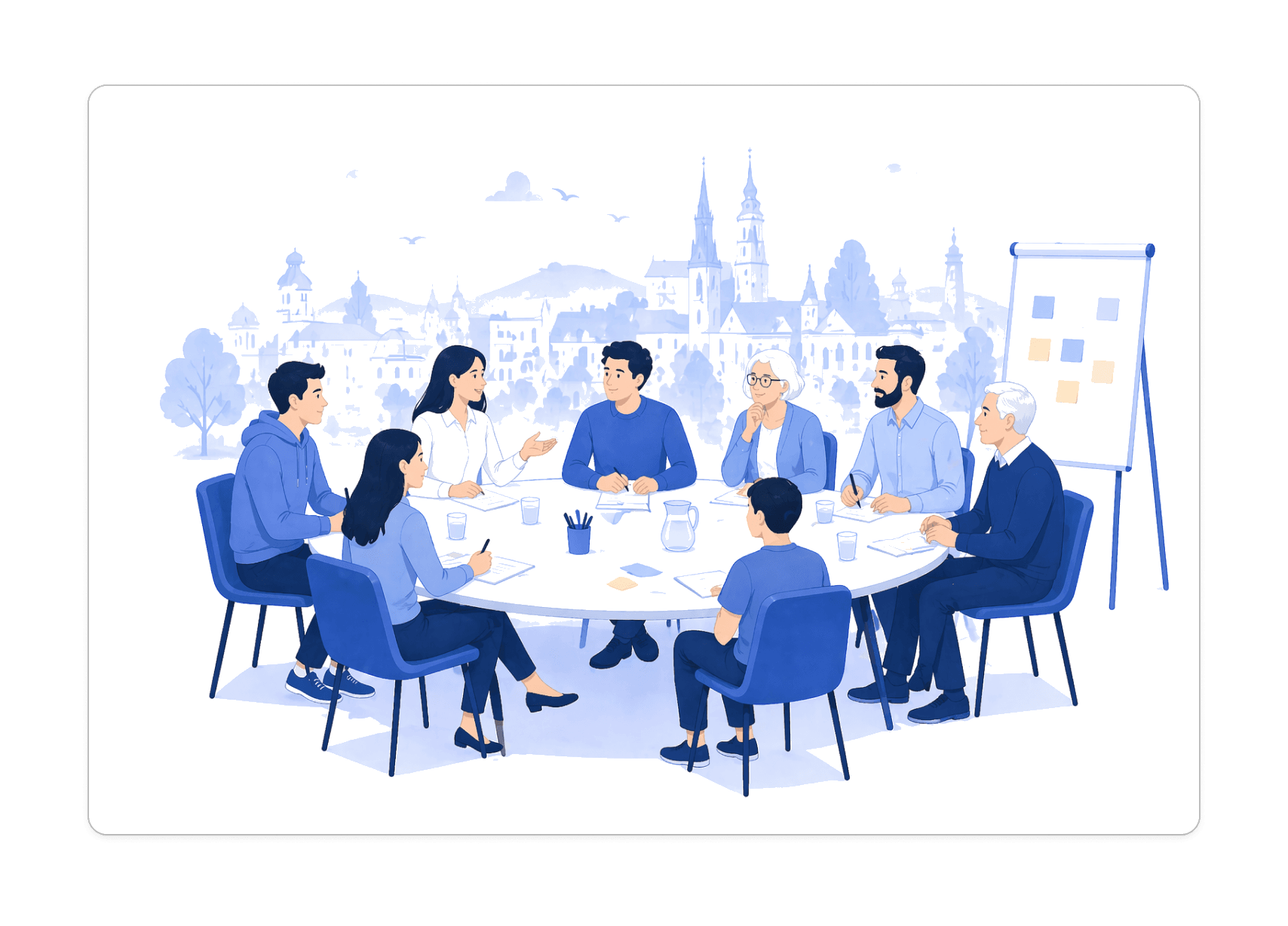
At one table, together.
A working meeting lasts the whole day. It consists of four parts that build on each other — from a shared opening, through expert inputs and facilitated discussion at the tables, to writing down concrete recommendations on flipcharts.
- WE ARRIVEPart 01
Building community
Before the draw the participants did not know each other. The day therefore starts with icebreakers, short games and splitting into tables of 10–15 people. The goal is simple: to feel safe to speak.
- Name tags by district
- A short introduction at the table
- Rules of discussion — simply and together
- WE LEARNPart 02
Informing & briefing
Participants hear experts from different sides — an economist, a lawyer, a sociologist, representatives of the neighbours concerned. They get printed materials and time to understand the question in depth.
- Short presentations, plenty of room for questions
- Materials and numbers on paper, so they can be revisited
- No party assistance, no political pressure
- WE DISCUSSPart 03
Facilitated discussion at the tables
At each table sits a facilitator, and in the thematic phase a lawyer too. We look for what the participants agree on — the overlap of opinions, not majority voting. The main value is understanding, not speed.
- Groups of 10–15 people
- Question, round, proposals, objections, agreement
- The rule "no one speaks while someone else has the floor"
- WE RECORDPart 04
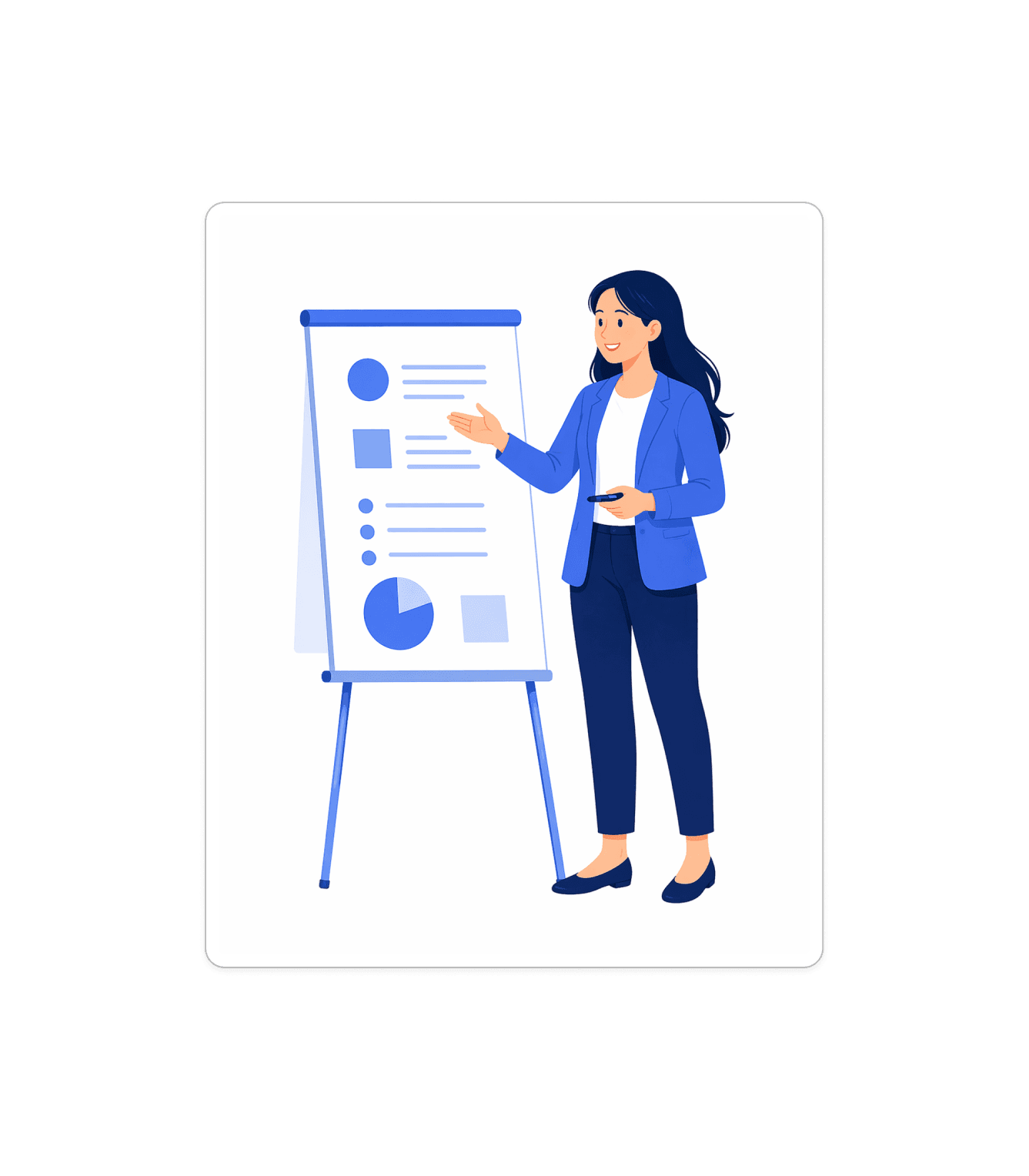
Presentation, flipchart, fixing it down
At the end of the day each table presents to the others and sums up what they reached. The conclusions hang on the flipchart, are photographed and transcribed into the record. Nothing gets lost — everything goes into the public library of materials.
- A short presentation by each table
- Flipcharts stay posted until the next meeting
- The record is traceable in the library of materials


STEP 05 · RECOMMENDATION
The outcome is a recommendation, not a decision.
The assembly formulates a recommendation. The final decision remains with the elected council — but with an obligation to respond to the recommendation publicly.
Recommendations are addressed to the institutions responsible for the given topic — from the council and the city all the way to government ministries. Exactly where they go depends on the topic and the place. For the short-term rentals topic in Prague 1 these are the institutions below — we also adopted a resolution addressed to the relevant ministry, and the petition will go in that direction too.
A public handover. Politicians respond to the recommendation point by point.
For topics that go beyond the competence of the city district.
For short-term rentals, the path runs through a petition to the petitions committee; the resolution also goes to the relevant ministry.
FREQUENTLY ASKED QUESTIONS
The questions we get most often.
-
The principle is general: the sample matches the composition of a given area. The process is currently running in Prague 1, so here we draw by lot according to three stratification criteria: place of residence (Old Town / New Town / Malá Strana + Hradčany), gender and age (15–29, 30–45, 46–60, 61–75, 75+). The draw is public and anonymous — it is drawn from the sequential numbers assigned at registration. In another area the criteria would be adapted to its composition.
-
It is a citizens' initiative arising from below, organised by the association Rozhodujme společně, z.s. — it is not an official decision-making body of the city district. We chose Prague 1 as a pilot because we have watched over much of its life right here: the co-founders live in this city district, work on participation and know what troubles people. We know the place, so this is where we could begin. We use public and expert materials, including the Sustainable Development Strategy of the Prague 1 district, but we leave the decision to the elected representatives — and ask them for a public response to the recommendations.
-
The recommendations are publicly handed over to the councillors of the Prague 1 district, the City of Prague and, where needed, the Chamber of Deputies. At the citizens' assembly the participants can also agree on other forms of supporting the solution of the topic than just handing over the recommendation — e.g. a joint open letter, a petition, a public dialogue with the institutions concerned, or actively tracking its fulfilment over time.
-
A poll captures an opinion at a given moment — without context, without studying the materials. A citizens' assembly gives people time to understand a problem in depth: hearing experts, weighing impacts, group discussion. The recommendations are an informed judgement, not a spontaneous reaction.
A referendum is a binding vote of all eligible voters with a clear "yes/no" result. A citizens' assembly, by contrast, works with a small statistically selected sample that takes the question apart in detail and formulates a non-binding recommendation — a basis for politicians, not a substitute for their decision.
-
The initiative is prepared by a small team of people voluntarily, in their free time and from their own resources. The association Rozhodujme společně, z.s. was registered on 28 April 2026 and we are currently setting up a transparent account. For financial support, please call Petr Rachunek at +420 774 701 779.